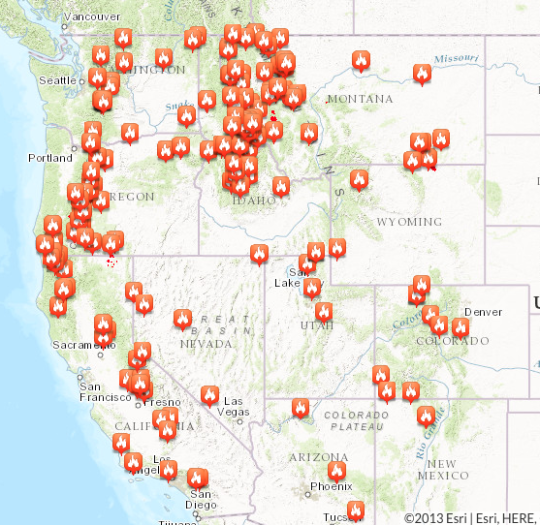
There are currently 74 wildfires burning in the western United States, many of them are approaching heavily populated cities such as Seattle, Portland, Sacramento, and Los Angeles. The La Tuna fire is now officially the brush fire in LA history. Air quality warnings are being issued across the entirety of Oregon, Washington, and Idaho. I’m in Portland, about 40 miles out from the nearest wildfire, and it’s raining ash and difficult to breathe due to the haze.
If you live anywhere near these fires, you’ve probably heard this by now, but please be safe. Stay indoors if at all possible and keep windows closed. Keep pets indoors as well. Hopefully some of our trademark Portland rain will come soon to help minimize the damage.
The thing with national awareness of western wildfires in the United states is that, because we have the fire season that happens concurrently with Summer, people have developed a situational blindness to them– so long as they are not personally effected.
Granted, there’s an odd sort of blindness turned toward fires in general in this country. Feel free to pull up the map here provided by the EPA and toggle through the options, click on each one to get some info on them–at least the names–and to see how many fires are currently burning. Most of the people reading this likely don’t know there’s more than one or two massive ones.
This is not really the fault of the average person, most fires tend to blur together and the USA is a big damn place. It gets more complicated the more detailed you look into things. Also known as: shit gets smokey and hard to follow. People can’t breathe correctly and it’s hard to communicate or track things. Exampled by the following:
In addition to the fires, the dots are varying levels of partical pollution detected around the united states.
Now, it’s not as if the people sitting around the fires aren’t yelling about the fact they are in fact on fire. It’s not that people in the distance aren’t noticing smoke. It is, again, that this– to some extent– happens every year.
Only, it doesn’t, not like this. In the last few years, we’ve had warmer and less snow heavy winters– at least in Washington. We don’t build up the snow pack that keeps the vegetation green sustainable, so what little we do have built up melts off rapidly– often before spring actually happens. This leads to flooding, this year especially, which causes rapid and uncontrollable growth in the plantlife that can’t be sustained once the water either seeps in or runs off. Likewise, we have people leaving their homes abandoned to fall to ruin due to flooding. And this overgrowth leads plants dying off in the heat that evaporates the floodwater, not to mention dry lightening and storms coming from the rising humidity, and said lightening hits the plants and we’re fucked. Sometimes it’s fighting in mud, sometimes it’s everything is dry and we just have to deal with dust and drought and the economy of farming areas being crap because no one could plant or harvest.
But my point: even though the weather is technically doing what it’s always done, it’s doing it in a vastly exaggerated manner. The system is not healthy and that needs to be addressed in the form of mass aid to prepare and deal with fires and so on– but because “it always happens every year” no one bothers.
And that needs to stop.
Because the death toll is going to be horrible, not just this year, but in the coming years if we just keep ignoring it.
Our children and our childrens’ children can’t be expected to live on inhalers and thick masks half the year, praying some of their number can stop a force of nature from devouring them. We and they don’t deserve to exist with ash clinging to their skin every moment, smoke in everything they do and not seeing a bird for months at a time and if they do it’s on the ground– suffocating.
If you can, volunteer to take a firefighter course and do something. I’m begging you. If you can’t, please spread this. We can’t, as a people, ignore this anymore.
what if i told you that a lot of “Americanized” versions of foods were actually the product of immigrant experiences and are not “bastardized versions”
That’s actually fascinating, does anyone have any examples?
I took an entire class about Italian American immigrant cuisine and how it’s a product of their unique immigrant experience. The TL;DR is that many Italian immigrants came from the south (the poor) part of Italy, and were used to a mostly vegetable-based diet. However, when they came to the US they found foods that rich northern Italians were depicted as eating, such as sugar, coffee, wine, and meat, available for prices they could afford for the very first time. This is why Italian Americans were the first to combine meatballs with pasta, and why a lot of Italian American food is sugary and/or fattening. Italian American cuisine is a celebration of Italian immigrants’ newfound access to foods they hadn’t been able to access back home.
(Source: Cinotto, Simone. The Italian American Table: Food, Family, and
Community in New York City. Chicago: U of Illinois, 2013. Print.)
me: but how am i supposed to recognize depressive episodes
me: [avoids social contact with anyone for like 2 days, lies awake in bed for 12 hours and then a bathtub for 5, listening to podcasts and not thinking about anything]




 ImmortalWave